
- Dongguan Zhuohang Ltd, founded 2005 — 6,800 m², 100+ employees, the floor behind the DFM review.
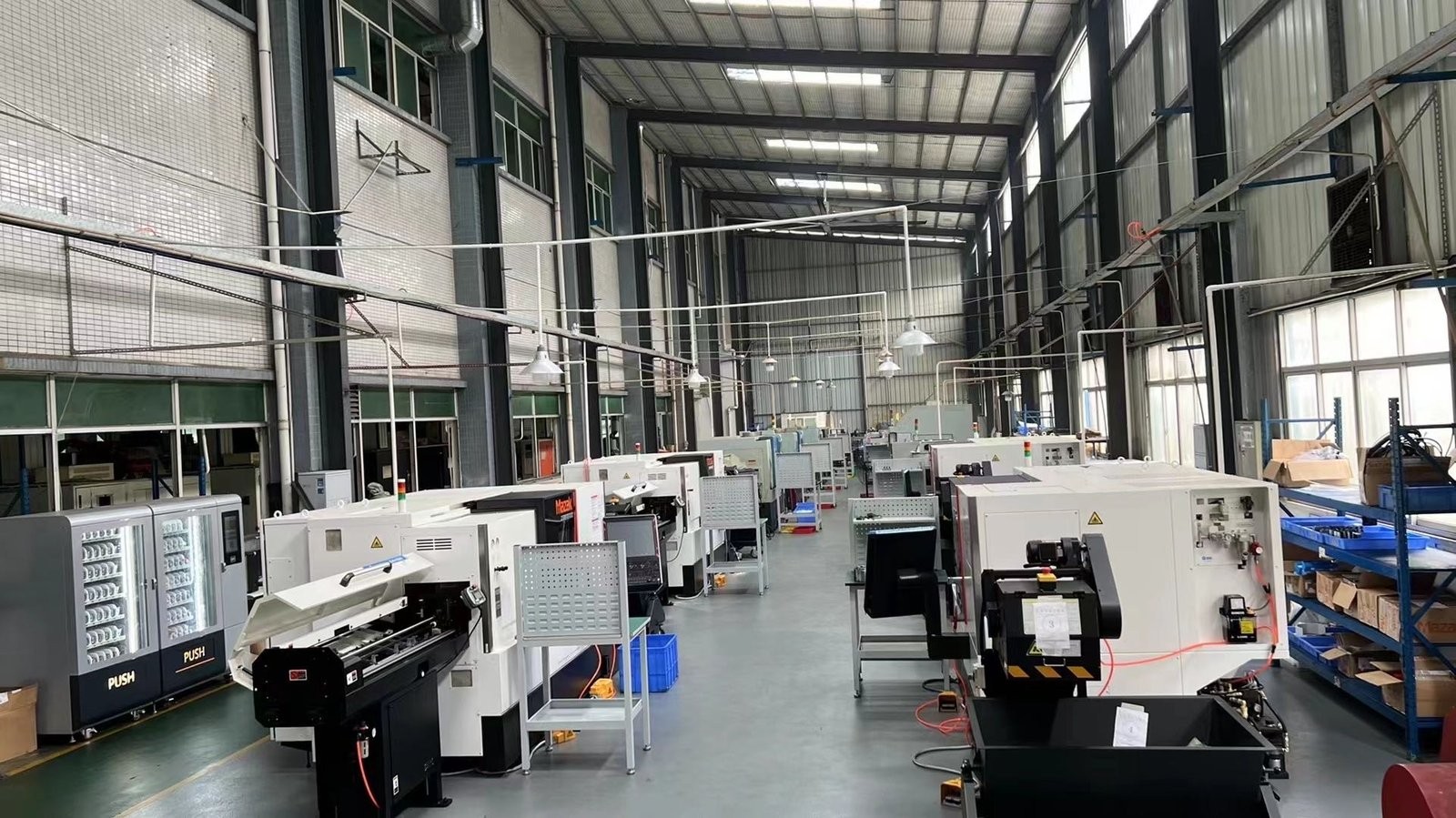
- 100+ production machines; milling to 1300 × 700 × 600 mm, turning to Ø720 × 1280 mm — range for any design.
- ISO 9001 + IATF 16949 + ISO 14001 — certificates behind the DFM review.
- No. 8, Shuibian Songyuan Road, Hengli Town, Dongguan, Guangdong, China 523470.
Why does process range matter to DFM?
DFM is only useful when the shop has the machines to act on its own advice. A factory with one kind of machine will try to force every design onto it; a factory with 3-axis, 4-axis, 5-axis, turning, mill-turn, and grinding can match the machine to the geometry. That is the difference between a design made the easy way and a design made the only way.
What machines run on the floor?
The floor holds 100+ production machines — 3-axis (50+), 4-axis (20+), and 5-axis (20+) machining centers, 25+ CNC lathes, and 7+ grinders — on Mazak and Brother milling and mill-turn centers and Citizen, Star, and Tsugami Swiss-type lathes. Milling runs to 1300 × 700 × 600 mm and turning to Ø720 × 1280 mm, so both small and large designs have a home.
How does the factory support the DFM review?
The DFM review is grounded in the actual floor: which machines are available, what envelopes they hold, and what tolerances they sustain. Milling and turning hold ±0.003 mm (milling) / ±0.002 mm (turning) and grinding holds ±0.002 mm, verified on Hexagon CMMs, so the review's advice about tolerances and process choice is based on measured capability, not a brochure.
| Factory capability | What it means for a DFM review |
|---|---|
| 3-axis, 4-axis, and 5-axis centers | The part routes to the lowest axis count that holds the geometry |
| CNC turning and mill-turn | Round and mixed parts stay on one floor, one clamping |
| Precision grinding | ±0.002 mm for bearing seats where ±0.003 mm (milling) / ±0.002 mm (turning) is not enough |
| Hexagon GLOBAL S CMMs and XRF | Advice grounded in measured capability, not a brochure |
| over a hundred machines across 6,800 m² | Process range to machine the design the easy way, not the only way |
What certificates back the factory?

Three certificates, all issued to Dongguan Zhuohang Ltd: ISO 9001:2015 (116024/A/0001/UK/En), IATF 16949:2016 (131941/A/0001/SM/En), and ISO 14001:2015 (116024/B/0001/UK/En). The IATF 16949 scope excludes product design under Clause 8.3 — the company is a build-to-print manufacturer whose DFM review guides manufacturability without over-claiming design responsibility.
How does the inspection bench confirm manufacturability?
The bench is the same class of equipment a buyer would use to audit the plant — Hexagon GLOBAL S CMMs, vision measuring machines, a gear measuring center, a KEYENCE VK-X3000 laser microscope, a SURFCOM 1800D, XRF material analysis, hardness testers, and salt-spray and tensile testers. In-house verification means the DFM promise — "this design machines cleanly" — is checked against measured values, not assumed.
How does the workforce make designs manufacturable?
DFM judgment lives in the people who read the drawings. The plant employs 100+ people, over 80% skilled technicians, and over 60% with five to ten years at the company — experience that recognizes a thin wall or an unreachable thread at a glance. That is the human half of the DFM equation, and it is not something a trading desk can replicate.
An experienced machinist reads a print the way you should want it read: spotting the thin wall, the unreachable thread, and the radius the drawing forgot. When you talk to a factory, listen for who answers. A person who can explain why a feature is hard to machine is worth more than a person who promises everything is easy. The DFM review is only as good as the eyes on the drawing.
Which industries does the factory serve?
The factory machines parts for automotive, robotics, electronics, medical, and automation equipment, in aluminum, stainless steel, carbon and alloy steel, brass, copper, titanium, magnesium, and engineering plastics. Domestic and overseas customers together exceed 100, with annual output above 1,000,000 pieces — volume that proves the DFM discipline scales.
How do you question a factory about its DFM claims?
A factory page can claim anything. Before you send a drawing, ask questions that separate a real floor from a trading desk:
- Who reads the drawing, and what do they flag? A machinist names the feature; a trader names the price.
- Which machines match my geometry? The answer should cite an axis count and an envelope, not "we do everything."
- Show the certificate numbers. ISO 9001:2015 (116024/A/0001/UK/En), IATF 16949:2016 (131941/A/0001/SM/En), and ISO 14001:2015 (116024/B/0001/UK/En) are verifiable; "ISO certified" is not.
- Where does the factory sit? No. 8, Shuibian Songyuan Road, Hengli Town, Dongguan, Guangdong, China 523470 is a real floor, and a real floor can be audited.
How do you audit a factory's DFM claims in person?
A factory page can claim anything; an audit verifies it. When you walk the floor, look for the things a trading desk cannot fake: the machines running real parts, the inspection bench with a current calibration sticker, and the people who can explain what they are cutting. The DFM review is only as real as the floor it describes.
The audit follows the DFM logic. Watch a part move from the machine to the CMM, and ask how the operator knows it is good. Look at the SPC charts — are they current, or are they framed decoration? Ask to see the material certificates and the XRF log. A factory that runs DFM as a habit shows evidence everywhere; a factory that runs it as a slogan shows evidence nowhere.
your rule is to audit the gap between the claim and the floor. A real floor has machines that match the machine list, certificates with numbers that check out, and people who read drawings the way a machinist should. A trading desk has a showroom and a list. The walkthrough tells you which one you are standing in.
What does the machine list actually tell you about capability?
A machine list is only useful if you read it the way a machinist does — for envelope, axis count, and spindle capability, not for brand names. Three questions turn a list into information:
- What envelope does each machine hold? Milling here runs to 1300 × 700 × 600 mm and turning to Ø720 × 1280 mm, so both small and large parts have a home. A machine that cannot fit your part is not on your list.
- How many axes? 3-axis, 4-axis, and 5-axis centers route different geometries to the right setup count. A list of only 3-axis machines means every angled feature pays for extra setups.
- What tolerance does the machine sustain, not just achieve? A machine that hits ±0.003 mm (milling) / ±0.002 mm (turning) on a good day is different from one that holds it by capability on a long run, which is what the Cpk record shows.
The machine brands — Mazak and Brother milling and mill-turn centers plus Citizen, Star, and Tsugami Swiss-type lathes — matter because they define the process envelope, but they are a means, not an end. The DFM review cares what the machine can do with your geometry, not whose name is on the casting.
How do a factory's location and logistics shape a DFM decision?
Location is a cost and a schedule variable, not just an address. A factory in Dongguan sits inside a dense machining supply chain, which means material, tooling, and secondary processes are nearby — shorter queues for anodizing, heat treatment, and plating, and fewer days lost moving parts between vendors. That proximity is part of why a DFM review made in Dongguan can be acted on quickly.
your DFM angle is the handoff count. Every time a part leaves the shop for a secondary process, the schedule and the tolerance are exposed. A factory with the finishing ecosystem next door keeps more of the part under one roof and one review, which is the same logic as mill-turn: fewer handoffs, less drift.
Logistics also sets the Incoterm and the shipment, which the DFM review factors into the total cost but does not fake — duty and freight are moving targets, so the disciplined move is to separate them from the part price and compare on the same term. The address at No. 8, Shuibian Songyuan Road, Hengli Town, Dongguan, Guangdong, China 523470 is a real floor with a real supply chain around it.
What does the inspection bench prove about a factory?
The inspection bench is where DFM advice is either confirmed or exposed. A factory that says "this design machines cleanly" should be able to show the measurement that proves it, and the bench here is built to produce that proof: Hexagon GLOBAL S CMMs, vision measuring machines, a gear measuring center, a KEYENCE VK-X3000 laser microscope, a SURFCOM 1800D, XRF material analysis, hardness testers, and salt-spray and tensile testers.
The point of that list is coverage, not bragging. A CMM checks position, size, and form; a vision machine catches small 2D features a touch probe cannot reach; the laser microscope and profilometer verify surface finish; the XRF confirms the alloy. Together they cover every claim the DFM review makes about the drawing — tolerance, finish, and material.
your rule is to ask which instrument verifies your critical dimension, and to see a report from it. A factory that names the instrument and shows the value is proving its claim; a factory that says "we check everything" without naming a tool is asking you to take it on faith.
How does a factory's capacity shape your volume decision?
Capacity is the difference between a prototype shop and a production partner, and DFM is the bridge between them. A part that machines easily on one machine is not necessarily a part that runs a thousand times on ten machines — the DFM review for volume asks whether the process is stable enough to repeat, which is a capacity question as much as a geometry question.
The floor here holds 100+ production machines across 6,800 m², with 100+ people and an annual output above 1,000,000 pieces, domestic and overseas customers together exceeding 100. That scale matters to a buyer because it means the process that validated your prototype is the same process that can carry the volume — the DFM discipline does not break when the quantity climbs.
Ask how a factory scales your part. A shop that validated one part and can name the machines and the SPC plan for a thousand has thought about production. A shop that validated one part and has no answer for the volume is a prototype shop wearing a production hat, and your DFM review should know the difference before you commit.
What this shop actually runs
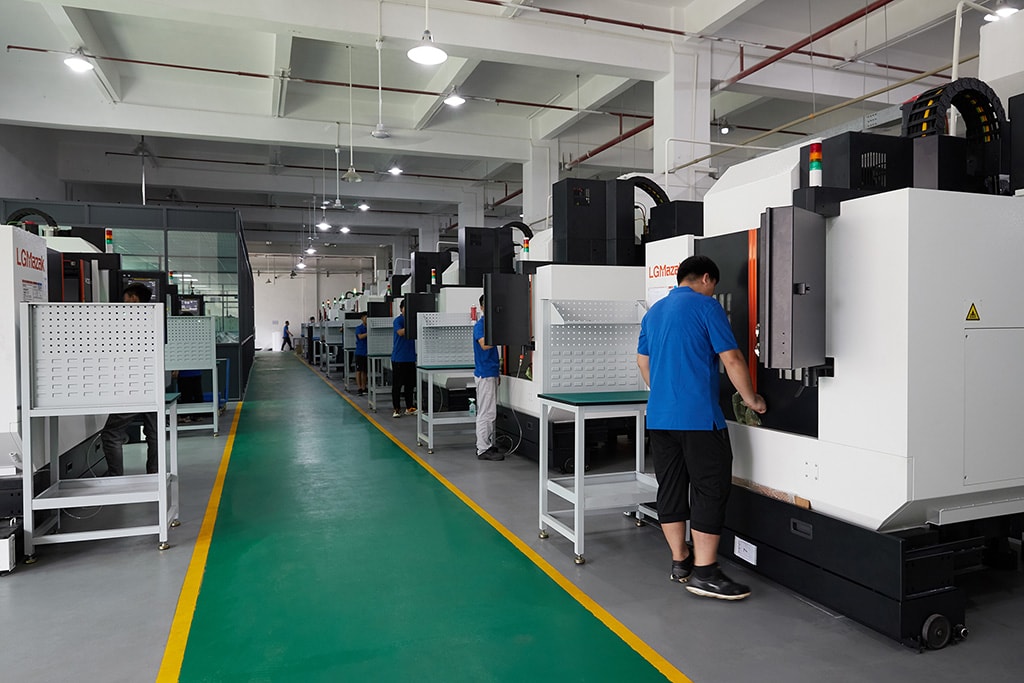
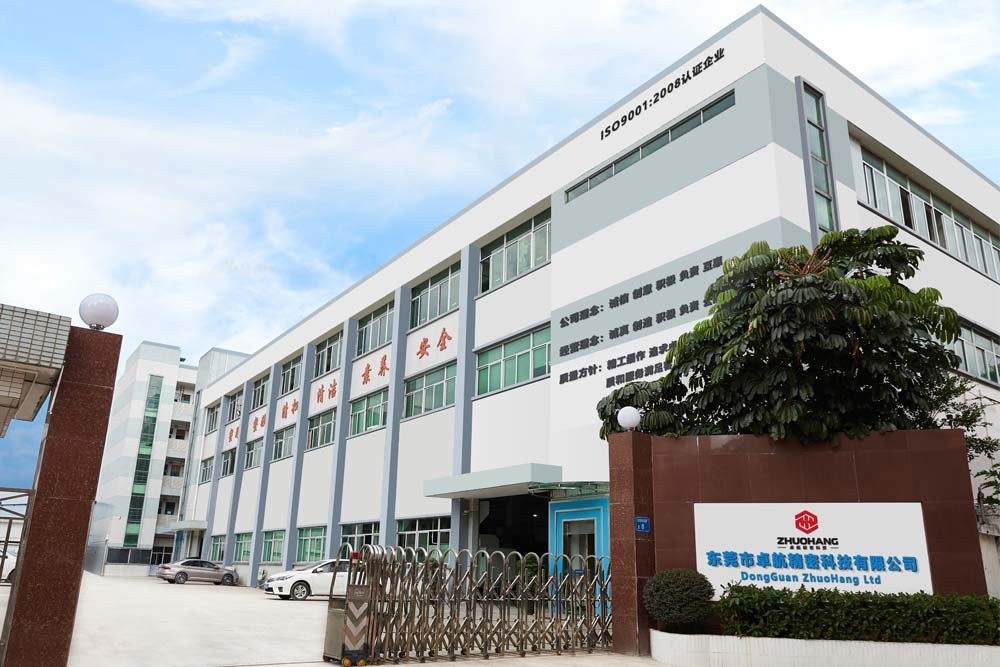
Capability evidence should come as specifics, not slogans. Behind this guide is a 6,800 m2 plant in Dongguan, China running 100+ CNC machines with 100+ staff. The machine list by category:
- 5-axis machining centres (10+) - Mazak VARIAXIS I-600 (510/910/510 mm travel, 12,000 rpm, 22 kW, 71.6 N·m, 30-tool BT40) and Mazak INTEGREX I-250H S (B-axis 0.0001°, 24 kW, 124 N·m, 38-tool HSK-A63). Geared to compound-angle parts, single-setup multi-face prismatic work, and aerospace fittings where datum transfer loss is unacceptable.
- 3-axis / 4-axis machining centres (50+) - Brother SPEEDIO S500Z2N / S700Z2N (10,000 rpm, 14/21-tool ATC, 0.7 s tool-to-tool, Z-axis 2.2 G) and Mazak VCE-430A L / VCE-570C L (10,000 rpm, 118 N·m, 24-tool ATC). Geared to prismatic parts, plates, brackets, housings.
- Swiss-type turning centres (10+) - Citizen Cincom A20-3F7 (Φ20 mm, 10,000 rpm), TSUGAMI B0206-III / B0205-III (Φ20 mm, 0.1 µm), STAR SR-32JII / SR-32J Type N (Φ32 mm, 8,000 rpm). Geared to long, slender rotational parts at ±0.002 mm.
- CNC turning centres (20+) - HEADMAN T70M/1250 (720 mm swing, 117 mm bore, 3,000 rpm, BMT75 12-station turret). Geared to shafts, bushings, flanges up to ±0.002 mm.
- Wire EDM (5+) - Sodick AQ535L (550/350/300 mm travel, ±20° taper, 800 kg workpiece). Geared to hardened tool steel, internal splines, sharp internal corners that milling cannot reach.
- Inspection: Hexagon CMM + 20+ gauges - Hexagon CMM for coordinate measurement, plus vision system, profilometer, hardness tester, coating thickness gauge, XRF for material verification. The 10:1 rule (gauge 10x more accurate than the band) is applied to every feature.
- Machine highlights - VARIAXIS I-600: one-setup multi-face 5-axis + MAZA-CHECK auto-calibration; INTEGREX I-250H S: DONE-IN-ONE mill-turn, B-axis 0.0001° + Ai thermal shield; SPEEDIO S500Z2N / S700Z2N: Z-axis 2.2 G + 0.7 s ATC; Swiss-type: guide-bush switchable + 0.1 µm resolution.
Tolerance: ±0.003 mm CNC milling / ±0.002 mm CNC turning / ±0.002 mm grinding and wire EDM. Capability: Ppk >= 1.67 initial on key characteristics, Cpk >= 1.33 ongoing.
Certificates: ISO 9001:2015 (116024/A/0001/UK/En), IATF 16949:2016 (131941/A/0001/SM/En, with design clause 8.3 excluded, stated openly) and ISO 14001:2015 (116024/B/0001/UK/En), issued to Dongguan Zhuohang Ltd, registration 91441900MA4UWT6X39, founded 2005.
Where we ship: Austria, Belgium, the Czech Republic, Denmark, France, Germany, Greece, Hungary, Ireland, Italy, the Netherlands, Spain, Sweden and the United Kingdom in Europe; Brazil, Canada, Mexico and the United States in the Americas; China, Israel, Japan, Singapore and Sri Lanka in Asia; Australia and New Zealand in Oceania; and South Africa in Africa — plus other countries and regions worldwide, shipped from our base in Dongguan, China.
Contact: Felipe Iglesias, [email protected], +86 13126536955.
Ready to machine your parts?
Send your drawing to [email protected] or call +86 13126536955 for a quote.
Frequently Asked Questions
Who is the entity behind the factory?
In short, Dongguan Zhuohang Ltd, brand Zhuohang Precision Machining Factory, founded 2005 at No. 8, Shuibian Songyuan Road, Hengli Town, Dongguan, Guangdong, China 523470, with 6,800 m² and over a hundred machines to act on DFM advice.
What certificates does the factory hold?
In short, ISO 9001:2015 (116024/A/0001/UK/En), IATF 16949:2016 (131941/A/0001/SM/En), and ISO 14001:2015 (116024/B/0001/UK/En), all under Dongguan Zhuohang Ltd; the IATF 16949 scope excludes design under Clause 8.3 because the company is a build-to-print manufacturer.
Why does process range matter to DFM?
A factory with 3-axis, 4-axis, 5-axis, turning, mill-turn, and grinding can match the machine to the geometry, while a one-machine shop forces every design onto that machine. Process range is what makes a DFM review actionable.
How large is the factory and its workforce?
The 6,800 m² floor holds 100+ production machines, and its 100+ people are over 80% skilled technicians, over 60% with five to ten years — experience that reads a drawing and spots a DFM trap at a glance.
What machine brands run on the floor?
Mazak and Brother milling and mill-turn centers plus Citizen, Star, and Tsugami Swiss lathes give the DFM review real machines to match a design to.
What is the largest workpiece the factory can machine?
Milling covers up to 1300 × 700 × 600 mm and turning up to Ø720 × 1280 mm, holding ±0.002 mm and grinding ±0.002 mm — room for most designs without a special setup.
Continue reading: Precision Machining CNC · Precision Machining CNC Services · Zhuohang Precision Machining Factory
Standards referenced on this page
- ASTM A582/A582M-12 — Standard Specification for Free-Machining Stainless Steel Bars
- IATF 16949:2016 — Automotive quality management system standard
- ASTM B348/B348M-21 — Standard Specification for Titanium and Titanium Alloy Bars and Billets